.














Compute Cable Tension B and Tension C
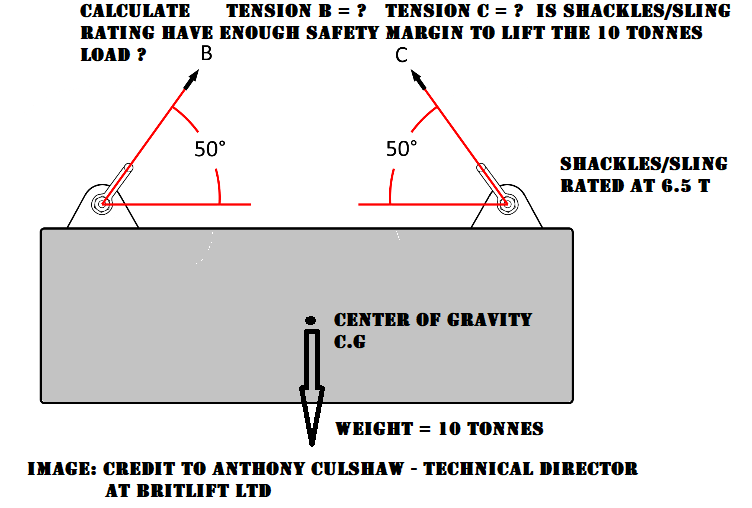
Find Tension T-B and T-C on shackles and sling created when lifting 10 Tonnes of load.
Given angle ∠ T-B, deg
Given angle ∠ T-C, deg
Given Weight, Tonnes
ANSWER: T-C =
Tonnes, Tension on cable T-C
ANSWER: T-B = Tonnes, Tension on cable T-B
Tensile strength vs Working load of a rope ? Explain the difference. How is this related to calculating the tension in order for the system of forces to remain in static equilibrium that you are trying to learn?
Assuming the rope used in above figure is 5/16 inch diameter with a tensile strength of 3,000 lbf (pound force) . Will the rope break when used to lift the load
weighing 10 Tonnes ?
Now assume again that you don't have any tensile strength data for 1/4 inch diameter rope. But you know by experience the tensile strength of 5/16 diameter of
rope is about 3,000 lbf. Will the 1/4 inch rope break when used to lift the 10 Tonnes load?
These are the types of questions technician, supervisor, engineer, manager or any person with responsibility to make safety decision in relation to equipment
or employee are facing from time to time. And since most of us forget our formula and calculator on how to calculate the tension
(related to tensile strength - breaking of rope or cable ) because we seldom use it. Would it be nice to have a smartphone apps to help us find the formula
and calculator to help us make safe decision at the moment we needed it? That is the reason why, INVBAT.COM was created to help any person who has
the responsibility to make safe decision.
credit to : https://www.ropeinc.com/
ropetensilestrength.html
Tensile strength is the average pound force where the new rope tested according to ASTM method D - 6268 standard is expected to break. While working
load is the rope's manufacturer recommended tensile strength with comfortable safety margin and longer usage of the rope. Usually the working load is
between 15% and 25% of the published tensile strength of the rope.
∑Fx=0 , This symbol means adding all the forces along x-axis, it must be zero for equilibrium.
∑Fx = 0
T-2x +
T-1x = 0
T-2x + T-1x =
100% of Tension 2 (T-2) is also the same as 100% of hypotenuse. Written in decimal form is (1)T-2 , which is the hypotenuse from the free body diagram of forces.
Memory recall lesson learned about vector addition, the hypotenuse, is also called the resultant vector. It is the result of adding the horizontal vector force of T-2 and the vertical vector force of T-2.
We are only interested in finding what is the value of horizontal vector force of T-2.
To do that we recall our lesson learned in Trigonometry about definition of Cosine. Now we can find the value of horizontal vector force of T-2, which is the value of adjacent side (0.7071).
You do the same analysis for the rest of computation.
|
|
|
|
|
|
∑Fy=0 , This symbol means adding all the forces along y-axis, it must be zero for equilibrium.
∑Fy = 0
T-1y + T-2y - W = 0
T-1y + T-2y = W , Given Data
|
|
|
|
|
|
ANSWER:
T-C =
Tonnes , Tension on cable T-C
T-B =
Tonnes ,Tension on cable T-B
Sine of angle = opposite side of angle divided by hypotenuse.
Cosine of angle = adjacent side of angle divided by hypotenuse
IN-V-BAT-AI Never Forget
AI Website
Memory Assistant Company
touch here to subscribe
IN-V-BAT-AI promise to deliver to subscriber:
1 click search, compute faster, and $1.70/month automated intelligent (AI) website memory assistant.