.


.

.
Enter your search prompt 54
Then click run button 
NO MORE LEARNING LOSS
Bus Fault Simulation of a four (4) Parallel Transformers
Interactive Calculator
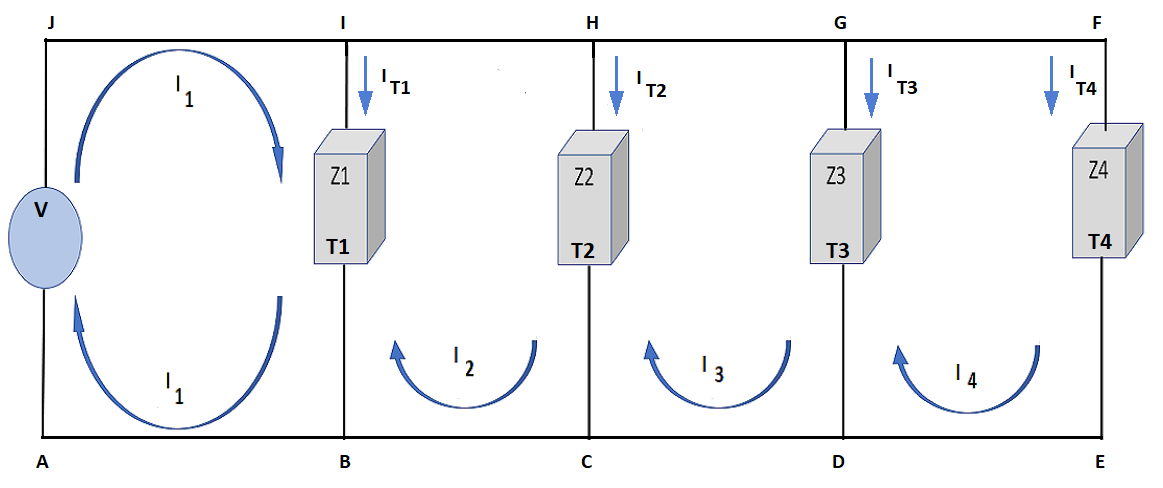


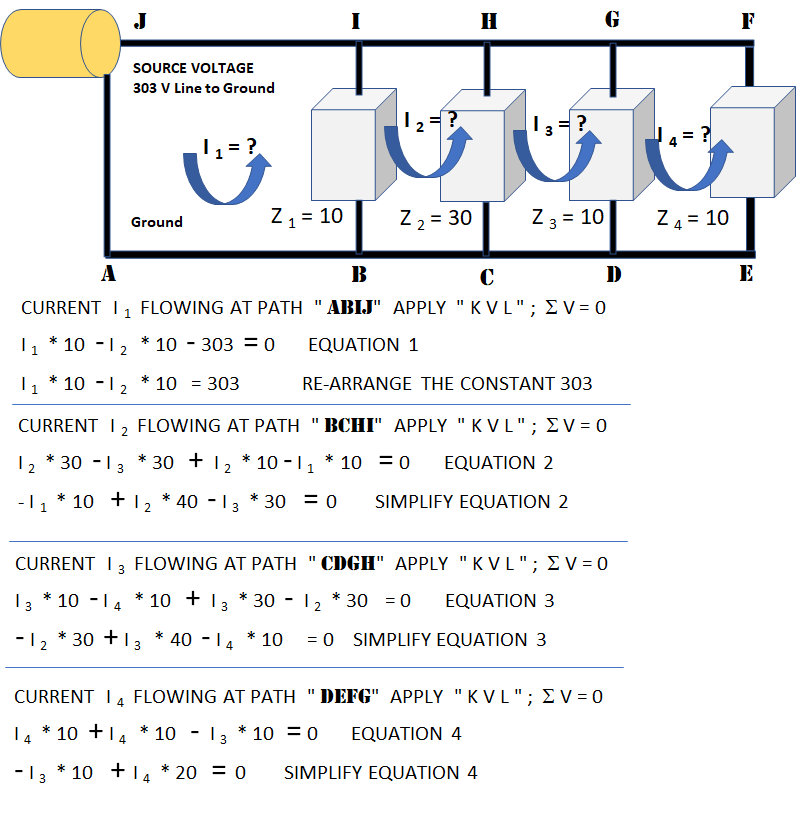
NOTE: If the transformer is out of service use Z = 1e9 (1,000,000,000) to simulate open circuit , transformer current should be almost zero.
| Singe Resistor | Z1 = 10 | Z2 = 1e9 | Z3 = 1e9 |
| Z4 = 1e9 | I = V / Z = 30.3 A Total current | ||
| Two Parallel Resistor | Z1 = 10 | Z2 = 10 | Z3 = 1e9 |
| Z4 = 1e9 | I = V / Z = 60.6 A Total current | ||
| Three Parallel Resistor | Z1 = 10 | Z2 = 10 | Z3 = 10 |
| Z4 = 1e9 | I = V / Z = 90.9 A Total current | ||
| Four Parallel Resistor | Z1 = 10 | Z2 = 10 | Z3 = 10 |
| Z4 = 10 | I = V / Z = 121.2 A Total current |
I 1 + I 2 + I 3 + I 4 = Equation 1
I 1 + I 2 + I 3 + I 4 = Equation 2
I 1 + I 2 + I 3 + I 4 = Equation 3
I 1 + I 2 + I 3 + I 4 = Equation 4
For SCENARIO ANALYSIS, assume all transformers have the same % Z value. You only need one through fault current from one transformer to get the constant voltage = IZ across the four banks of transformer. Then you can do quick adjustment of voltage to approximate the known through fault current from one faulted transformer. You can get this through fault current from PMU data, DFR, or SEL 87T relay.
Z 1 = 10 Ω
Z 2 = 30 Ω
Z 3 = 10 Ω Z 4 = 10 Ω
V L-G = 303 V Voltage adjustment to approximate the known through fault current. Next you apply the appropriate % Z of each transformer and you will get the approximate through fault current for the remaining three banks of transformer.
Practice : Z 1 = 0.092 Ω
Z 2 = 0.092 Ω
Z 3 = 0.092 Ω
Z 4 = 0.092 Ω
V L-G = 303 V
Given PMU through fault for Transformer T2 = 1054 A. What is the adjusted voltage to simulate a 1054 A through fault assuming all transformers have the same % Z of 0.092? ANSWER = 97 V. Using the 97 V as your voltage source to let through fault current of 1054 A flow through Transformer T2. Now you are ready to estimate the through fault current passing through Transformer T1, T3, and T4 using their actual nameplate impedance value.
What is the estimate thru fault current for T1 at Z1 = 0.096 ; T3 at Z3 =0.065 ; T4 at Z4 = 0.0623
Using back substitution to find value of I 1, I 2 and I 3.
INITIAL CONDITION :
Answer, I 1 = 101.00
XF 1 Load current; I 1 - I 2 = 30.30
Answer, I 2 = 70.70
XF 2 Load current; I 2 - I 3 = 10.10
Answer, I 3 = 60.60
XF 3 Load current; I 3 - I 4 = 30.30
Answer, I 4 = 30.30
XF 4 Load current; I 4
Result of Gaussian elimination
Important definition to remember about row echelon. The process of reducing augmented matrix in row echelon form is called Gaussian elimination
1. The first nonzero entry in each row is always 1
2. A row with more leading zero entries compare to the previous row must be located below.
3. A row with all zero entries must be below the rows having nonzero entries.
Gaussian elimination will not work properly if one of the definition is violated.
Operation 1 - The order in which any two equations are written may be interchanged.
Operation 2 - Both sides of the equation may be multiplied by the same nonzero real number.
Operation 3 - A multiple of one equation may be added to another equation.
IN-V-BAT-AI
The Personal AI Tutor Company
SOLVING THE LEARNING LOSS PROBLEM

Open More Calculator Database
Why do you need a personal augmented intelligence (AI) assistant? Because it is useful in knowledge storage, information retrieval,
and fast computation with less error. Because personal AI assistant is a new tool supporting research discovery on how people learn, retained knowledge,
generate new knowledge, improve reasoning and understanding.
IN-V-BAT-AI uses explainable Artificial Intelligence (AI) to automate repetitive solved problem or routine calculation so we can focus our brain power to solve harder new problem then automate again once it is solved.
Learn Once and Never Forget
Now Possible !
 Available ads space $1.03 per day
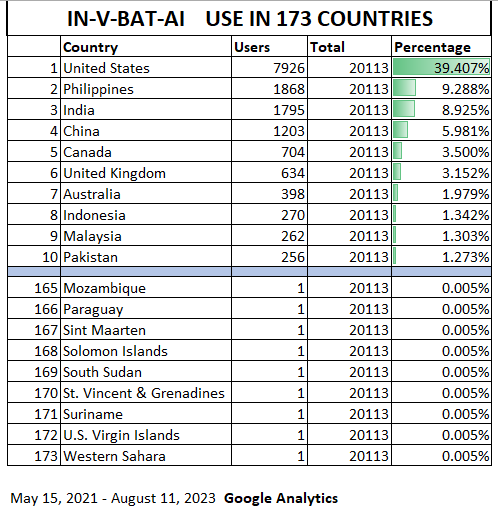
Here comes the disruptive innovation from IN-V-BAT-AI , today the problem of remembering formula and the correct sequence of data entry is now solved
by combining formula and calculation and make it on demand using smartphone, tablet, notebook, Chromebook, laptop, desktop, school smartboard and
company big screen tv in conference room with internet connection.