


 Touch image to subscribe $26.40/year
Learn Once and Never Forget Now Possible !
Subscribe to Personal AI $26.40/year
BIL - Basic Impulse Level
Reviewer


12/17/2016 : updated knowledge contributed by Transformer Professionals W.B & J.S
I don't have their permission to write their names or their initial names but I would like to give them the proper credit for sharing their acquired knowledge about BIL for the benefits of future power transformer engineers.


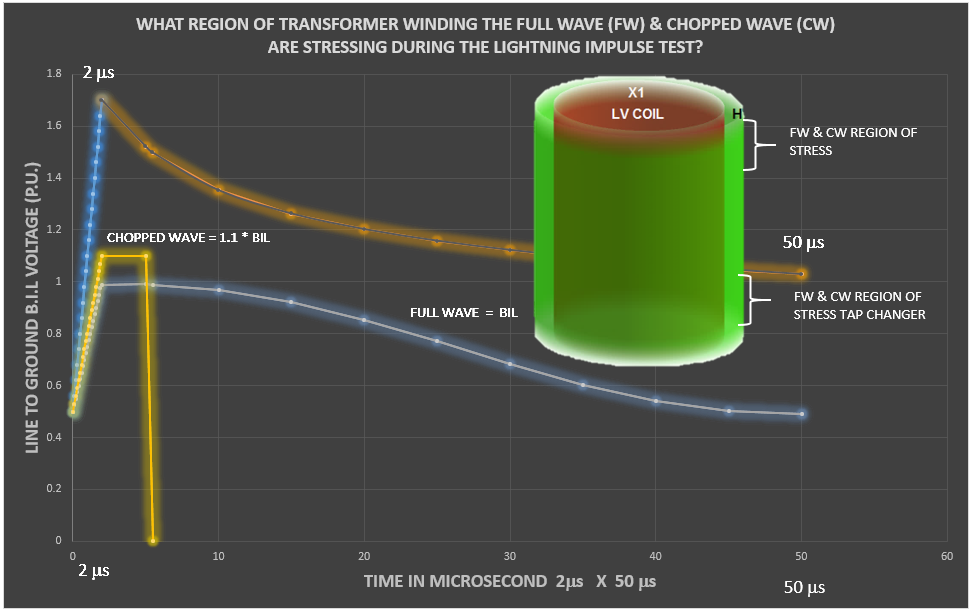
Is lightning impulse a good example of
partial discharge. What do you think ?
Partial Discharge Measurement and Simulation from CWIEME
Click the play button to watch the presentation in You Tube
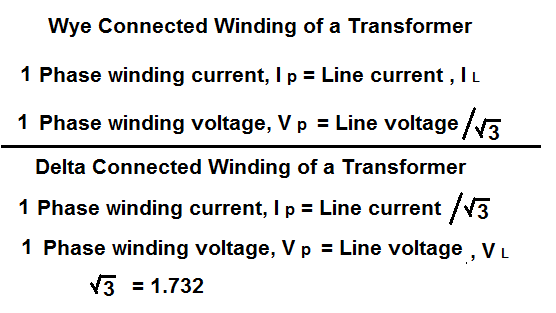
The De-Energized Tap Changer (DETC) of a 3 phase power transformer was set at primary voltage of 67 kV and the OnLoad Tap Changer (OLTC) at secondary winding is set at 13.75 kV as the rated voltage also called the secondary voltage. If you look at transformer nameplate, the neutral voltage is indicated by letter "N"; Calculate the Voltage Ratio at the given DETC & OLTC tap settings. This voltage ratio or turn ratio is your baseline value for a healthy transformer with respect to normal winding turn to turn ratio. If there is no turn to turn short circuit on your primary windings or secondary windings the voltage ratio value or turn ratio value should remained very close to your voltage ratio baseline value. Assuming that the instrument was properly calibrated.
Valid for 3 Φ , Δ - Y only
|
3 phase voltage Ratio, a = 1 phase voltage ratio * 1.732
|
= |
Primary Voltage
Secondary Voltage
|
Click white input box to enter new number


If your primary winding is shorted, you will expect to have a lower turn ratio (a) in your TTR measurement compare to factory test report. It is also indicated by lower primary voltage reading. Use the calculator below to do simulation. What will happen to your primary voltage if your TTR reading goes down to 7.125?
Valid for 3 Φ , Δ - Y only
Given three phase turn ratio 8.4396 and Secondary voltage 13.75 kV; Calculate the expected primary voltage
|
three phase turn ratio, a
|
= |
Primary Voltage
/ 1.732 Secondary Voltage
|
Click white input box to enter new number
If your secondary winding is shorted, you will expect to have a higher turn ratio (a) in your TTR measurement compare to factory test report. It is also indicated by lower secondary voltage reading. Use the calculator below to do simulation. What will happen to your secondary voltage if your TTR reading goes up to 9.521?
Valid for 3 Φ , Δ - Y only
Given a three phase turn ratio 8.4396 and Primary voltage 67 kV; Calculate the expected secondary voltage
|
three phase turn ratio, a
|
= |
* 1.732 Primary Voltage
Secondary Voltage
|
Click white input box to enter new number
Knowing the factory report of voltage ratio (TTR) of the above 3 phase transformer as 8.4396 your baseline for a healthy condition, what do you think happen to the same transformer if the voltage ratio (TTR) from the latest test report is 7.3163 ? Can you estimate the coil location of the Turn to Turn winding short? Can you tell which side of the winding (HV or LV) the Turn to Turn winding short happen? Can you make a generalization about the location of the turn to turn winding short if the TTR test report value is less than the baseline TTR value?
Knowing the factory report of voltage ratio (TTR) of the above 3 phase transformer as 8.4396 your baseline for a healthy condition, what do you think happen to the same transformer if the turn to turn ratio (TTR) from the latest test report is 9.1247? Can you estimate the coil location of the Turn to Turn winding short? Can you tell which side of the winding (HV or LV) the Turn to Turn winding short happen? Can you make a generalization about the location of the turn to turn winding short if the TTR test report value is greater than the baseline TTR value?
Valid for 1 Φ only
Given single phase voltage ratio of 4.8727 and Secondary voltage 13.75 kV; Calculate the expected primary voltage
|
Voltage Ratio, a , single phase
|
= |
Primary Voltage
Secondary Voltage
|
Click white input box to enter new number
Valid for 1 Φ only
Given Turn Ratio, a , single phase 5.333 and Primary voltage 69 kV; Calculate the expected secondary voltage
|
Turn Ratio, a
|
= |
Primary Voltage
Secondary Voltage
|
Click white input box to enter new number
Assuming from your transformer design review you learned that the primary coil winding turns is 484 for 67 kV tap setting on your DETC and the secondary coil winding turns is 90 to get 12.47 kV and set at Neutral tap setting on your OLTC. Calculate your transformer turn to turn ratio using the given number of turns as your baseline for a healthy condition.
Valid for 1 Φ only
Given primary coils number of turns = 484 and secondary number of turns = 90
Calculate the expected Turn to Turn Ratio (TTR).
|
Turn Ratio, a , single phase
|
= |
Primary Coils
Secondary Coils
|
Click white input box to enter new number
Valid for 1 Φ only
Given Turn ratio = 5.3778 and Secondary number of turns = 90; Calculate the expected primary number of turns of coil
|
Turn Ratio, a , single phase
|
= |
Primary Coils
Secondary Coils
|
Click white input box to enter new number
Valid for 1 Φ only
Given Turn Ratio, a , single phase = 5.3778 and Primary number of turns = 484; Calculate the expected secondary number of turns of coil
|
Turn Ratio, a , single phase
|
= |
Primary Coils
Secondary Coils
|
Click white input box to enter new number
Given Secondary FLA = 1296.41 and Primary FLA = 241.28; Calculate the expected turn ratio
|
Turn Ratio, a , single phase
|
= |
Secondary current
Primary current
|
Click white input box to enter new number
Valid for 1 Φ only
Given Turn Ratio, a , single phase = 5.3778 and Primary FLA = 241.28; Calculate the expected secondary full load ampere (FLA)
|
Turn Ratio, a
|
= |
Secondary current
Primary current
|
Click white input box to enter new number
Valid for 1 Φ only
Given Turn Ratio, a , single phase = 5.5334 and Secondary FLA = 1296.41; Calculate the expected primary full load ampere (FLA)
|
Turn Ratio, a
|
= |
Secondary current
Primary current
|
Click white input box to enter new number
Valid for 3 Φ only
Given 3 Phase MVA rating = 28 and Secondary voltage = 69 kV; Calculate the expected primary full load ampere (FLA)
3 Phase MVA RATED POWER TRANSFORMER
|
Primary, Amp
|
= |
3 Phase MVA Rating
Primary kV * 1.732
|
Click white input box to enter new number
Valid for 3 Φ only
Given Secondary FLA = 1296.41 and Secondary voltage = 12.47 kV; Calculate the expected 3 Φ MVA rating of transformer
|
Secondary, Amp
|
= |
3 Phase MVA Rating
Secondary kV * 1.732
|
Click white input box to enter new number
Valid for 3 Φ only
Given 3 phase kVA = 1000 and Primary voltage = 480; Calculate the expected primary full load ampere (FLA)
3 Phase KVA RATED POWER TRANSFORMER
|
Primary, Amp
|
= |
3 Phase kVA Rating
Primary V * 1.732
|
Click white input box to enter new number
Valid for 3 Φ only
Given Secondary FLA = 2405.70 and Secondary voltage = 240; Calculate the 3 Φ kVA rating of transformer
|
Secondary, Amp
|
= |
3 Phase kVA Rating
Secondary V * 1.732
|
Click white input box to enter new number
Valid for 3 Φ only
Given Primary FLA = 1202.85 and 3 phase kVA = 1000; Calculate the expected primary voltage
|
Primary, Amp
|
= |
3 Phase kVA Rating
Primary V * 1.732
|
Click white input box to enter new number
Open More Calculator Database
Why do you need a personal augmented intelligence (AI) chatbot? Because it is useful in data storage, information retrieval, and fast computation with less error.
IN-V-BAT-AI uses explainable Artificial Intelligence (AI) to automate repetitive solved problem or routine calculation so we can focus our brain power to solve harder new problem then automate again once it is solved.
Learn Once and Never Forget
Now Possible !

Click here for chatbot subscription
USED IN 207 COUNTRIES
Organic Growth

INVBAT.COM - A.I. is a disruptive innovation in computing and web search technology. For example scientific calculator help us speed up calculation
but we still need to remember accurately the formula and the correct sequence of data entry. Here comes the disruptive innovation from INVBAT.COM-A.I. ,
today the problem of remembering formula and the correct sequence of data entry is now solved by combining formula and calculation and make it on demand
using smartphone, tablet, notebook, Chromebook, laptop, desktop, school smartboard and company big screen tv in conference room with internet connection.