🔗Never Forget — Your Daily Recall + Calculator for just 8¢/day
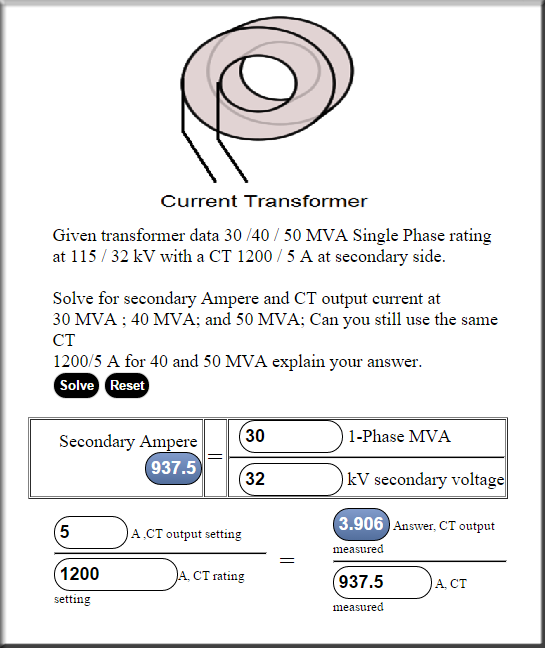
Given transformer data 30 /40 / 50 MVA Single Phase rating
at 115 / 32 kV with a CT 1200 / 5 A at secondary side.
Solve for secondary Ampere and CT output current at 30 MVA , 40 MVA, and
50 MVA. Can you still use the same CT 1200/5 A for 40 and 50 MVA explain your answer.


Valid for 1 Φ only
|
Secondary Ampere
| = |
1-Phase MVA
kV secondary voltage
|
|
A ,CT Rating
A, CT Rating
|
= |
A, CT measured
A, CT measured
|
When there is a short circuit the secondary voltage goes down very low. At that instant the current is approaching its maximum value. For example when the secondary voltage drop to 2 V due to short circuit, the secondary ampere current will be 15,000. Try it.
When you download the transformer differential relay or breaker relay data you will see close to 62.5 A secondary ampere reading during fault which is 62.5 A x 240 the CT ratio equals to 15,000 ampere.
3 Phase Transformer CT Output Calculator
Same Problem as above but now it is 3 phase rating:
Given transformer data 320 base MVA three phase rating
at 525 / 230 kV with a CT 2000 / 5 A at primary winding side.
Using the base 320 MVA solve for primary ampere and CT output current . Assuming a voltage dip of 50 kV at the primary side. Estimate the fault current at the primary side using only the 50 kV voltage dip recorded by your Pi historian or differential relay data.
Assuming the transformer % Z ( impedance) = 6.9 % . What is the maximum available short circuit current the transformer was designed to withstand? if the voltage dip goes down to 12 kV , what is the primary short circuit current? What do you think will happen to the transformer at this fault level?
Primary ampere and primary voltage were shown. To calculate the secondary current use secondary voltage.
SHORT CIRCUIT CURRENT
|
Primary Ampere
| = |
3 Phase MVA
kV * 1.732 primary voltage
|
|
A ,CT Rating
A, CT Rating
|
= |
A, CT measured
A, CT measured
|
IN-V-BAT-AI helps you recall information on demand—even when daily worries block your memory. It organizes your knowledge to make retrieval and application easier. 🔗
Source: How People Learn II: Learners, Contexts, and Cultures
Copyright 2025
Never Forget with IN-V-BAT-AI
INVenting Brain
Assistant Tools
using Artificial Intelligence
(IN-V-BAT-AI)
Since
April 27, 2009
April 27, 2009