
Assume voltage or current waveform frequency
is 60 cycles/sec or 60 Hz
is 60 cycles/sec or 60 Hz
cycle
= millisecond

° degree
= milliseconds
° degree
= cycle
Assume voltage or current waveform frequency
is 50 cycles/sec or 50 Hz
cycle
= millisecond
° degree
= millisecond
° degree
= cycle
Assume voltage or current waveform frequency = 100,000 cycles/sec or 100 kHz
This visualization is useful in analyzing transient recovery overvoltage (TRV) due to restrike voltage in SF6 Gas in Extra High Voltage Power Circuit Breakers.
The normal operating frequency of EHV Power Circuit Breaker in the U.S. is 60 Hz. If the breaker is calibrated to trip at 2 cycles out of 60 Hz , it means the operating speed of the breakers is 33.33 millisecond not including the time delay for relay operation. TRV is very fast in 20 nanosecond up to 10 microsecond.
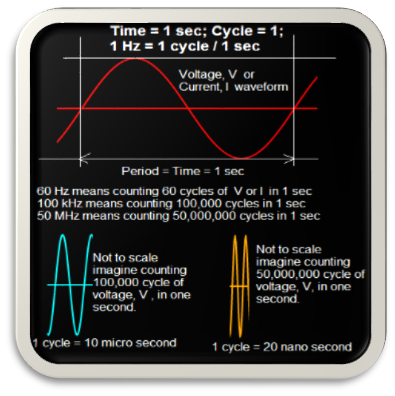
ASSUME FREQUENCY AT 100 kHz
cycle
= microsecond
10 microsecond = 10µsec = 10 x 10-6 second =10 e-6 second = 0.000010 sec
ASSUME FREQUENCY AT 50 MHz
cycle
= nanosecond
20 nanosecond = 20 nsec = 20 x 10-9 second =20 e-9 second = 0.000000020 sec
For 60 Hz
1 cycle * sec /60 cycles = 0.0166667 seconds = 16.667 milliseconds
360 electrical degree = 1 cycle
1 ° degree = 1/360 cycle = 0.002778 cycle
For 50 Hz
1 cycle * sec /50 cycles = 0.02 seconds = 20 milliseconds
Angular Degree to Radian Calculator
radian
= degree
Review of Sampling Frequency
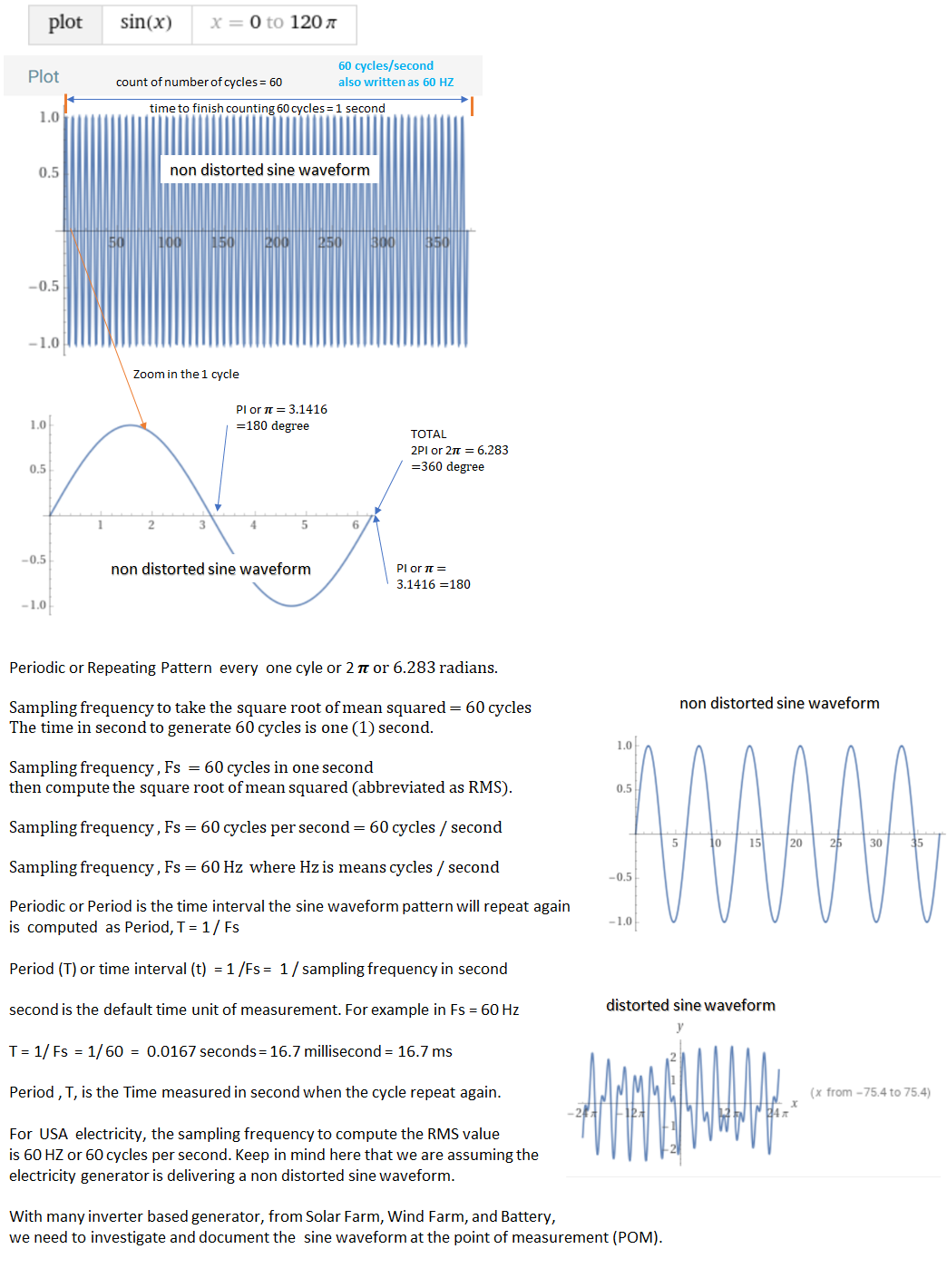
Sampling Frequency Reviewer
 Fundamental (60Hz) + 3rd (1 peak) + 5th (1 peak) + 7th (1 peak) Harmonic Addition


Fundamental (60Hz) + 3rd (2 peak) + 5th (1.5 peak) + 7th (1 peak) Harmonic Addition

Fundamental (60Hz)(8 peak) + 3rd (4 peak) + 5th (6 peak) + 7th (3 peak) Harmonic Addition

Fundamental (60Hz) + 5th (1 peak) Harmonic Addition

Fundamental (60Hz) + 3rd (1 peak) Harmonic Addition

Fundamental (60Hz) + 7th (1 peak) Harmonic Addition

Fundamental (60Hz) + DC (0.80 peak) + 3rd (1 peak) + 5th (1 peak) Harmonic Addition


Electro Magnetic Transient Program Simulation Waveform (EMTP) shared in LinkedIn by Bahram Khodabakhchian
Given the distorted waveform from EMTP study how can we do fast fourier transform (fft) to discover the dominant frequency of voltage or current?
We comply with LinkedIn Embed Term of Use
Fast Fourier Transform shared in LinkedIn by: Source Credit to:
Bingsen Wang, PhD
Global Manager, HV Safety Integration at Stellantis, SMIEEE
We comply with LinkedIn Embed Term of Use
IN-V-BAT-AI helps you recall information on demand—even when daily worries block your memory. It organizes your knowledge to make retrieval and application easier. 🔗
Source: How People Learn II: Learners, Contexts, and Cultures
| Year: 2026 | Top 10 countries | # Pages / Visitors |
| Daily Site Visitor Ranking 1/11/2026 | 1. USA 2. China 3. Japan 4. Australia 5. India 6. Brazil 7. Ukraine 8. Argentina 9. Canada 10. Poland | Year to Date 7,847 Pageviews 3,856 Unique Visitors |
Copyright 2026
Never Forget with IN-V-BAT-AI
INVenting Brain
Assistant Tools
using Artificial Intelligence
(IN-V-BAT-AI)
Since
April 27, 2009
April 27, 2009