INVBAT.COM
FORMULA AND CALCULATOR
Phone - Tablet - Laptop - Desktop
We Do Customize Calculator
Subscribe
Reviewer in Static
and Calculator
Static is a computational analysis study to determine that a rigid body under analysis will remain in equilibrium state or static. In order for a rigid body to remain in static equilibrium, the summation of all acting forces on a rigid body must be equal to zero.
In mathematical formula :
∑Fx=0 , This symbol means adding all the forces along x-axis, it must be zero for equilibrium.
∑Fy=0 , This symbol means adding all the forces along y-axis, it must be zero for equilibrium.
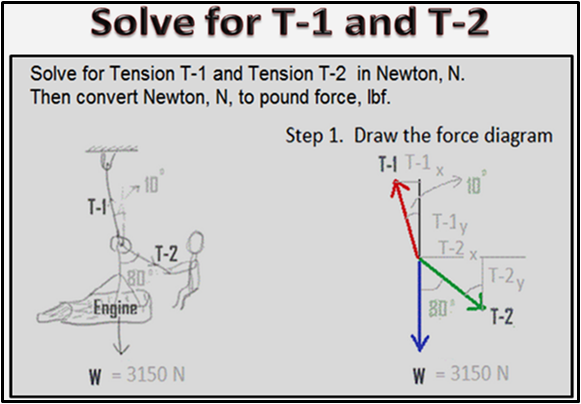
HOW TO USE: Enter new number in white input box. Answer is automatic. This template plus your smartphone will help you to calculate solution for similar problem in 60 seconds. To prove it, what is the tension of T-1 & T-2 if the weight = 6000 N. Answer T-1 = 6286 N ; T-2 = 1108 N
Given angle in degree ∠ T2 ,
Given angle in degree ∠ T1 ,
Given weight, in N, Newton


ANSWER: T-1 =
N,
ANSWER: T-1 = lbf, pound force
ANSWER: T-2 = N,
ANSWER: T-2 = lbf, pound force
∑Fx=0 , This symbol means adding all the forces along x-axis, it must be zero for equilibrium.
∑Fx = 0
T-2x +
T-1x = 0
T-2 + T-1 = Equation 1
|
Given ∠ T2
Sine ° |
= |
T-2 , opposite side
T-2 , hypotenuse
|
|
Given ∠ T1
Sine ° |
= |
T-1 , opposite side
T-1 , hypotenuse
|
∑Fy=0 , This symbol means adding all the forces along y-axis, it must be zero for equilibrium.
∑Fy = 0
T-1y + T-2y + W = 0
T-1 +
T-2 =
W equation 2
Then using your acquired knowledge of solving two simultaneous linear equations to find the value of T-1 and T-2.
|
Given ∠ T2
Cosine ° |
= |
T-2 , adjacent side
T-2 , hypotenuse
|
|
Given ∠ T1
Cosine ° |
= |
T-1 , adjacent side
T-1 , hypotenuse side
|
ANSWER:
T-1 = N
T-2 = N
Formula Recall:
Sine of angle = opposite side of angle divided by hypotenuse.
Cosine of angle = adjacent side of angle divided by hypotenuse


to use the calculator
