Never Forget
IN-V-BAT-AI. Try It.


🎯 Never Forget What Matters.
Trusted automation intelligence from every solved problem. Save time. Reduce stress. Decide smarter.
Subscribe today—because your memory deserves a backup.
$120 per school per year
click to read more

Enter or say keywords, phrases, and numbers using AI voice-to-text, then tap "SEARCH 2"
Compute the Net Present Value
Compute the Net Present Value
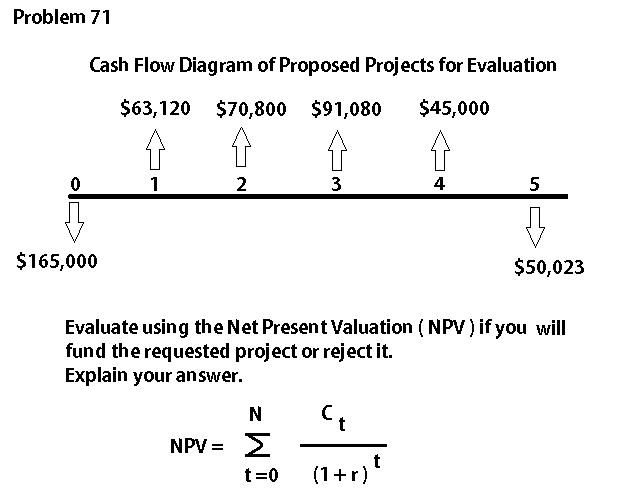
Cash flow diagram of proposed project for evaluation is shown below. Evaluate using the net present valuation (NPV) if you will fund the requested project or reject it. Explain your answer.
HOW TO USE: Select any input box. Answer will be automatic
You would like to make decision to fund the project or reject it. You are using the net present value ( NPV ) to help you in making decision. If the NPV is positive you will proceed to fund the project. If the NPV is negative you will reject the project.
Year = 0, means initial expected expenses to fund the project
The discount rate is at % for
year,
and your initial cash expenses $
at the end of year.
Initial cash flow expenses to fund the project =


Year = 1, means projected income after first year of the project
The discount rate is at % for
year,
and projected income for first year $
at the end of year.
Present value of cash flow income =
Year = 2, means projected income after second year of the project
The discount rate is at % for
year,
and projected income for second year $
at the end of year.
Present value of cash flow income =
Year = 3, means projected income after third year of the project
The discount rate is at % for
year,
and projected income for third year $
at the end of year.
Present value of cash flow income =
Year = 4, means projected income after fourth year of the project
The discount rate is at % for
year,
and projected income for fourth year $
at the end of year.
Present value of cash flow income =
Year = 5, means projected expenses after fifth year of the project
The discount rate is at % for
year,
and projected expenses for fourth year $
at the end of year.
Present value of cash flow projected expenses =
The NPV formula is telling you to add all the projected expenses or income at 12% borrowing rate
Year 0 = -165,000 +
Year 1 present worth value of income projected at present using 12% borrowing rate = 56,357 +
Year 2 present worth value of income projected at present using 12% borrowing rate = 56,441 +
Year 3 present worth value of income projected at present using 12% borrowing rate = 64829 +
Year 4 present worth value of income projected at present using 12% borrowing rate = 28,598 +
Year 5 present worth value of expenses projected at present using 12% borrowing rate = -28,384
After simply adding the total expenses and income projected at present value using bank borrowing rate of 12% you will get the Net Present Value of the money. Usually the bank rate is lock for the year of the project so there is no uncertainty. If the bank interest rate is fluctuating there is no certainty, some money lender will add safety factor by offering higher interest rate. Example is the personal loan lender, when they fund a borrower with no collateral there is no certainty that they can get some portion of the principal money that they approved for a personal loan. So they add safety factor by using higher interest rate so they can collect faster their money. When unfortunate event happens to a borrower towards the end of their loan period, they probably collected their principal plus earned interest.
Net Present Value (NPV) =
If the NPV is positive fund the project. Otherwise reject the funding request.
Formula Recall
Where C = means Future Cash Income or Expenses Projected
Where NPV = means Net Present Value
Where r = means discounted rate for C
Where N = means number of years money is discounted for present value
NPV = Σ C ( 1 + r ) - N
The initial pattern of solving this type of problem is remembering the formula. Next mastering how to use your personal online calculator. Now you have your tool for computational thinking. You can do quick analysis. For example you can adjust the discounting rate to 6% , then enter the projected income and expenses. Tip do not enter dollar $ sign or comma symbol because you will get an error message of NaN, meaning Not a Number data entry.
Practice using your online personal calculator by using the data shown below.
| Discounting rate | 6% |
| Initial Cash Expenses | 300,000 |
| 1st year income | 63,120 |
| 2nd year income | 70,800 |
| 3rd year income | 91,080 |
| 4th year income | 45,500 |
| 5th year expenses | 50,000 |
.
IN-V-BAT-AI helps you recall information on demand—even when daily worries block your memory. It organizes your knowledge to make retrieval and application easier.
Source: How People Learn II: Learners, Contexts, and Cultures
.
How can IN-V-BAT-AI be used in classrooms ?
IN-V-BAT-AI is a valuable classroom tool that enhances both teaching and learning experiences. Here are some ways it can be utilized:
☑️ Personalized Learning : By storing and retrieving knowledge in the cloud, students can access tailored resources and revisit
concepts they struggle with, ensuring a more individualized learning journey.
☑️ Memory Support : The tool helps students recall information even when stress or distractions hinder their memory, making it
easier to retain and apply knowledge during homework assignments or projects.
☑️ Bridging Learning Gaps : It addresses learning loss by providing consistent access to educational materials, ensuring that
students who miss lessons can catch up effectively.
☑️ Teacher Assistance : Educators can use the tool to provide targeted interventions to support learning.
☑️ Stress Reduction : By alleviating the pressure of memorization, students can focus on understanding and applying concepts,
fostering a deeper engagement with the material.
🧠 IN-V-BAT-AI vs. Traditional EdTech: Why "Never Forget" Changes Everything
📚 While most EdTech platforms focus on delivering content or automating classrooms, IN-V-BAT-AI solves a deeper problem: forgetting.
✨Unlike adaptive learning systems that personalize what you learn, IN-V-BAT-AI personalizes what you remember. With over 504 pieces of instantly retrievable knowledge, it's your cloud-based memory assistant—built for exam prep, lifelong learning, and stress-free recall.
📧 No coding, no hosting—just email what you want to remember
📱 Live within 24 hours, optimized for mobile and voice search
💸 $30/year for 504 personalized memory recall sites (just 6¢ each)
"🧠 Forget less. Learn more. Remember on demand."
That's the IN-V-BAT-AI promise.
🧠 Augmented Intelligence vs Artificial Intelligence
Understanding the difference between collaboration and automation

🔍 Messaging Contrast
Augmented Intelligence is like a co-pilot: it accelerates problem-solving through trusted automation and decision-making, helping you recall, analyze, and decide — but it never flies solo.
Artificial Intelligence is more like an autopilot: designed to take over the controls entirely, often without asking.
💡 Why It Matters for IN-V-BAT-AI
IN-V-BAT-AI is a textbook example of Augmented Intelligence. It empowers learners with one-click recall, traceable results, and emotionally resonant memory tools. Our “Never Forget” promise isn't about replacing human memory — it's about enhancing it.

Note: This is not real data — it is synthetic data generated using Co-Pilot to compare and contrast IN-V-BAT-AI with leading EdTech platforms.


.





.
.
🎉 72,133 Visitors 11/14/25
IN-V-BAT-AI just crossed 72,133 organic visits—no ads, just curiosity and word-of-mouth.
Every visit is a step toward forgetting less, recalling faster, and remembering on demand.
Never Forget. Learn on demand.
🔗 SubscribeTry AI website hosting
$30 per year
| Year | Top 10 countries | Pages visited |
| 2023 | 1. USA 2. Great Britain 3. Germany 4. Canada 5. Iran 6. Netherlands 7. India 8. China 9. Australia 10. Philippines | 127,256 Pages / 27,541 Visitors |
| 2024 | 1. USA 2. China 3. Canada 4. Poland 5. India 6. Philippines 7. Great Britain 8. Australia 9. Indonesia 10. Russia | 164,130 Pages / 40,724 Visitors |
| Daily Site Visitor Ranking 11/14/2025 | 1. Israel 2. USA 3. China 4. Vietnam 5. Japan 6. India 7. Australia 8. Argentina 9. Brazil 10. Ukraine | Year to Date 204,611 Pages / 72,133 Visitors |
Data source: Advanced Web Statistics 7.8
Approximately between 2.3 and 2.5 million schools globally, according to the latest available data from government and education ministry reports.
🔗 The challenges schools face: 2025/2026 🔗 USA ~ Public 98,500 ~ Private 30,000 ~ Total 128,500 🔗 Canada ~ Public 15,500 ~ Private 2,000 ~ Total 17,500 🔗 Brazil ~ Public 138,000 ~ Private 40,000 ~ Total 178,000 🔗 Vietnam ~ Public 42,000 ~ Private 8,000 ~ Total 50,000 🔗 China ~ Public 217,200 ~ Private 152,800 ~ Total 470,000 🔗 India ~ Public 1,022,386 ~ Private 335,844 ~ Total 1,358,230 🔗 Japan ~ Public 30,240 ~ Private included ~ Total 30,240 🔗 Morocco ~ Public 20,600 ~ Private 6,300 ~ Total 26,900 🔗 Indonesia ~ Public 390,718 ~ Private included ~ Total 390,718 🔗 Philippines ~ Public 47,831 ~ Private 13,000 ~ Total 60,831 🔗 Great Britain ~ Public 29,202 ~ Private included ~ Total 29,202 🔗 Australia ~ Public 9,653 ~ Private included ~ Total 9,653 🔗 Russia ~ Public 39,070 ~ Private included ~ Total 39,070 🔗 Germany ~ Public 31,039 ~ Private included ~ Total 31,039 🔗 Poland ~ Public 36,291 ~ Private included ~ Total 36,291 🔗 Iran ~ Public 80,000 ~ Private included ~ Total 80,000 🔗 France ~ Public 58,100 ~ Private included ~ Total 58,100 🔗 Mexico ~ Public 132,505 ~ Private included ~ Total 132,505