Never Forget Again
🌍 Trusted by 243,234 learners in 149 countries
Your brain stores knowledge in neuron connections called synapses. When those connections or links fade, you forget.
THE SOLUTION: IN-V-BAT- AI

















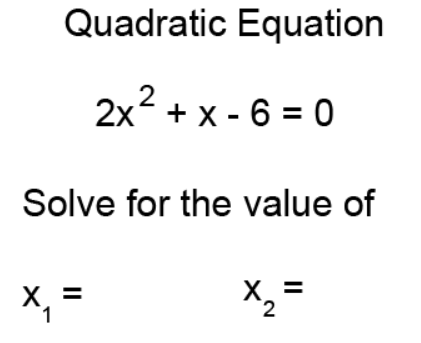
Quadratic Equation
Never Forget Again
.
INSTRUCTION ON HOW TO USE:
Enter 2 in input box X 2 and 1 in input box X
then - 6. You will get factors in simplified form
X2 +
X +
= 0
X1 = Answer X2 = Answer
( X + )
( X + ) = 0
ANSWER : FACTORS X1 and X2
Knowing how to factor quadratic equation is useful when solving limit problem.


Why is the right side of the quadratic equation equal to zero (0)? Answer, it is usually set to zero to compute the initial condition when the y-axis value is set to zero (0). Written mathematically, y(x) = 0 or f(x) = 0 meaning the y output value or the y-axis value is set to 0 to compute the corresponding x1 and x2 input values. So y(x) or f(x) = 2 x 2 + 1 x - 6
becomes 0 = 2 x 2 + 1 x - 6
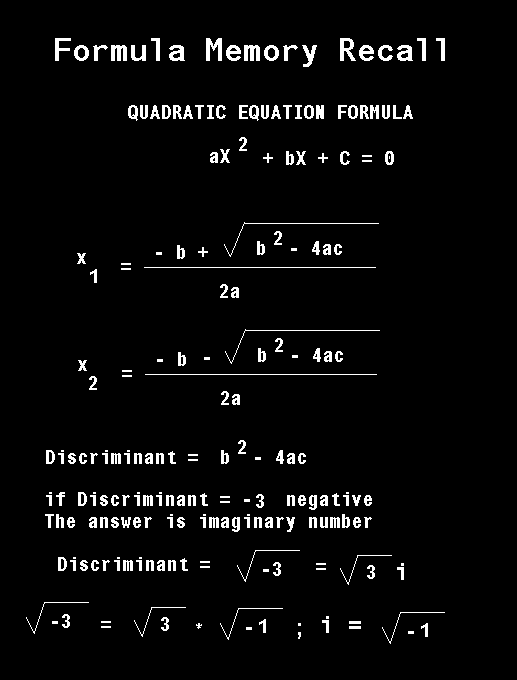
If the answer is NaN (Not a Number). It means the answer is imaginary number . See explanation below
Now you have a tool for computational thinking. You can do quick analysis. For example you can adjust 2 to 8, 1 to -1 and -6 to -11 . Tip do not enter comma symbol because you will get an error message of NaN, meaning Not a Number data entry.
First root: X1 = If answer is NaN, it means the answer is imaginary number.
X1 = b + i The answer is imaginary number.
Second root: X2 = If answer is NaN, it means the answer is imaginary number.
X2 = b - i The answer is imaginary number.
Manual solution using quadratic equation formula. Formula makes automation possible
X1 = ( b + Square Root ( b2 - 4 a * c ) ) / 2 * a
X1 = ( b + Square Root ( ) ) / =
Manual solution using quadratic equation formula. Formula makes automation possible
X2 = ( b - Square Root ( b2 - 4 a * c ) ) / 2 * a
X2 = ( b - Square Root ( ) ) / =
APPLICATION OF LESSON LEARNED:
Example (X + 2)(X - 1.5) = 0 is equivalent to quadratic equation x2 + 0.5 x - 3 = 0
(X + 2)(X - 1.5) = 0 means when the value of y is set to zero (0) you can solve the value of x as shown by the graph below. (X + 2)(X - 1.5) = y(0)
y(0) is interpreted as , you set the value of y equal to zero then solve for the value x. Then you will get a pair coordinates (-2, 0 ) and (1.5, 0 )
y(1) is interpreted as, you set the value of x equal to 1 then solve for the value y. The answer is y(1) = -1.5 . Now you will have a new coordinate point (1, -1.5) and (-1, -1.5).
y(x) can be interpreted as the generalized quadratic equation or parabolic equation meaning you can assigned any real number value for x-coordinate and you can predict or infer a corresponding y-coordinate value.
y(x) is sometimes written as f(x) meaning the output value f(x) is a function of any input value of x. The lesson you learned about x-coordinate and y-coordinate is very important
concept that you needed in real work application like in ANOVA statistical analysis, SCADA Pi display dashboard, computer animation, and factory automation.
Below is the solution using graphing method
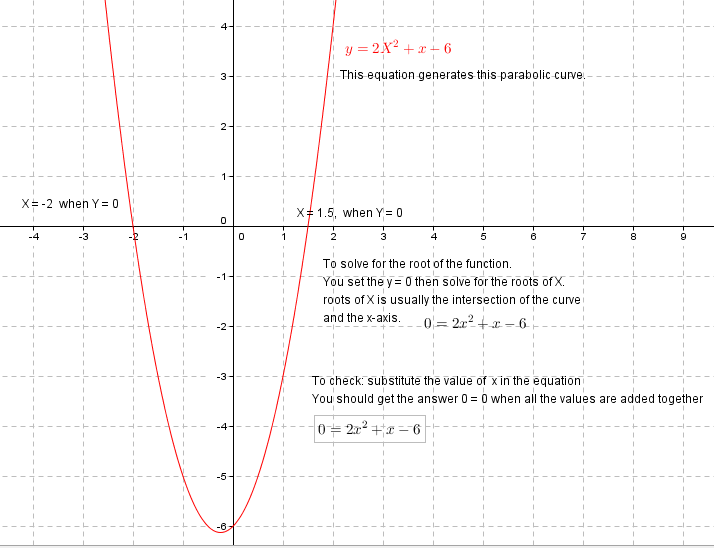
Graph created using GeoGebra
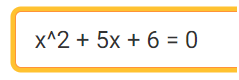
Click the link to solve using Wolfram Alpha
.
.
.
.
.
.
.
.
.
Copyright 2026
Never Forget Again with IN-V-BAT-AI
INVenting Brain
Assistant Tools
using Artificial Intelligence
(IN-V-BAT-AI)
Established 2009
Unique visitors as of 9/26/2026 = 243,234
from 141 countries
Unique visitors as of 9/26/2026 = 243,234
from 141 countries